Your Journey of Healing
The Book of Ruth | Redemption, Faithfulness & Restoration | Sunday School Lesson PDF
The Book of Ruth | Redemption, Faithfulness & Restoration | Sunday School Lesson PDF
Couldn't load pickup availability
The Book of Ruth | Redemption, Faithfulness & Restoration
DIGITAL PRODUCT — PDF DOWNLOAD
No physical product will be shipped.
“Where you go I will go, and where you stay I will stay.” — Ruth 1:16
The Book of Ruth begins with famine, grief, and empty hands.
It ends with provision, restoration, family, and a place in the lineage of Jesus Christ.
Between those two places is a beautiful story of ordinary faithfulness and extraordinary providence.
The Book of Ruth is a Scripture-centered Sunday School lesson exploring Ruth, Naomi, and Boaz and the powerful themes woven throughout their story: grief, loyalty, obedience, redemption, providence, kindness, restoration, and the sovereign hand of God.
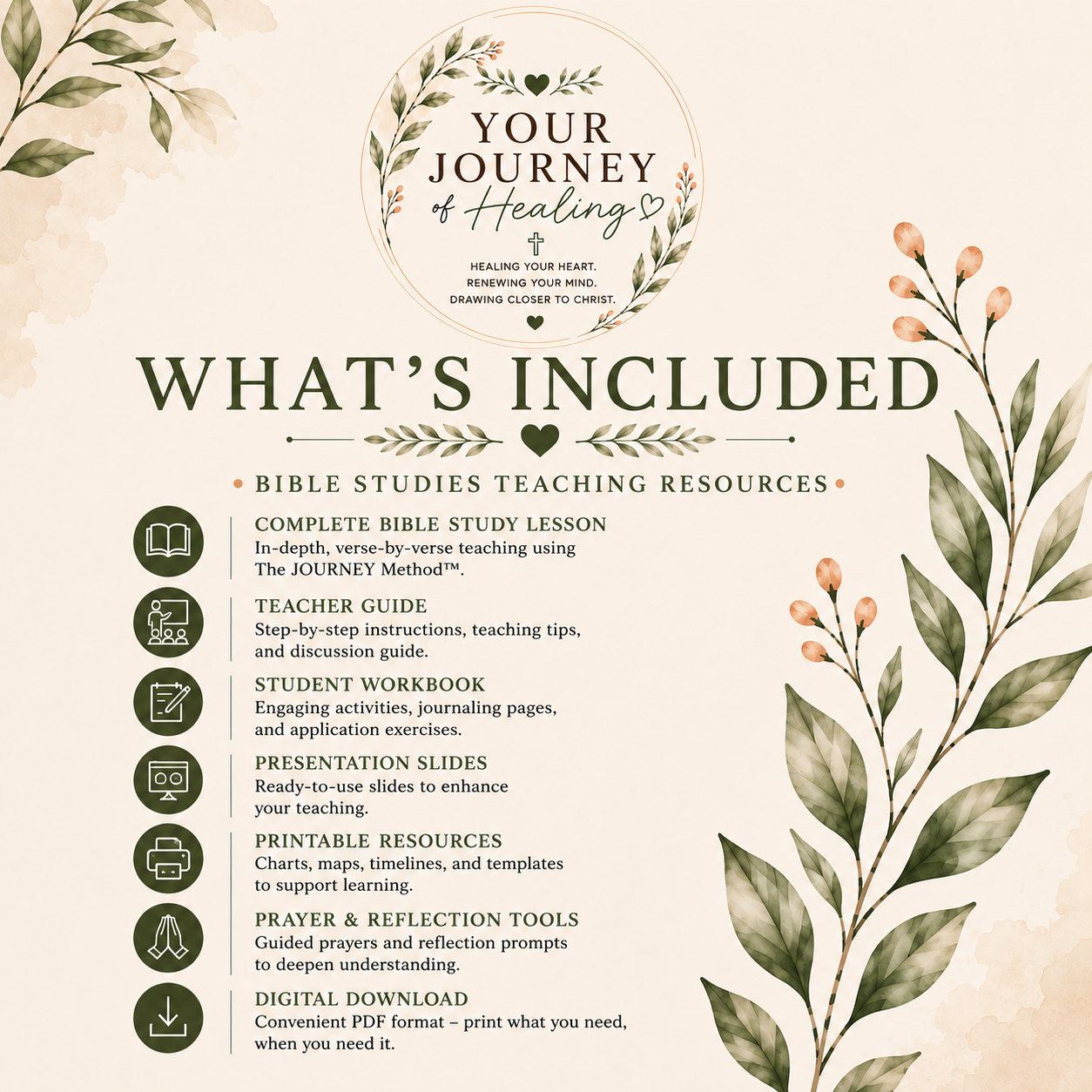
Inside This Lesson
- Biblical and historical context of Ruth
- Overview of Ruth chapters 1–4
- Naomi’s journey through devastating loss
- Ruth’s decision to remain with Naomi
- Ruth’s remarkable declaration of loyalty
- Leaving Moab and beginning again
- Ruth gleaning in the fields of Boaz
- God’s providence in seemingly ordinary circumstances
- Boaz’s character, kindness, and integrity
- Understanding the kinsman-redeemer
- Ruth’s courageous obedience
- Naomi’s journey from emptiness toward restoration
- Ruth and Boaz’s marriage
- Ruth’s place in the genealogy of Jesus
- Practical application and reflection questions
- Group discussion prompts
- Prayer and personal response opportunities
When the Story Begins With Loss
Ruth does not begin like a beautiful love story.
It begins with famine.
Displacement.
Death.
Naomi loses her husband and both of her sons.
She eventually says:
“I went away full, but the LORD has brought me back empty.”
Naomi could see what she had lost.
She could not yet see what God was preparing.
Sometimes we evaluate the entire story from the chapter we are currently living.
Ruth reminds us:
Do not mistake an empty chapter for a finished story.
Ruth Chose Faithfulness
Ruth had every reason to return to what was familiar.
Instead, she tells Naomi:
“Where you go I will go.”
Her commitment goes even deeper:
“Your people will be my people and your God my God.”
Ruth steps into an uncertain future with remarkable loyalty and faith.
She does not know Bethlehem.
She does not know Boaz.
She does not know how provision will come.
She simply takes the next faithful step.
“As It Turned Out…”
Ruth goes into the fields to glean.
Scripture tells us she finds herself working in a field belonging to Boaz.
From Ruth’s perspective, she is simply looking for food.
From the perspective of the entire story, providence is unfolding.
This is one of Ruth’s most beautiful lessons.
God can be working through circumstances that look completely ordinary.
A field.
A conversation.
A relationship.
A seemingly insignificant decision.
Not every work of God arrives with thunder.
Sometimes providence looks remarkably ordinary while we are living through it.
Boaz the Kinsman-Redeemer
Boaz becomes one of the central figures in Ruth’s story.
He is compassionate.
Generous.
Protective.
Honorable.
And eventually, he acts as a kinsman-redeemer.
In Israelite law, the role of the redeemer involved protecting family interests and preserving what might otherwise be lost.
Boaz’s actions become a beautiful picture of redemption.
And Ruth’s story ultimately points beyond Boaz toward the greater Redeemer:
Jesus Christ.
From Empty to Full
Naomi returned to Bethlehem believing she had nothing.
But God was not finished.
By the end of the story, the women of Bethlehem are celebrating restoration with her.
Her circumstances did not erase her grief.
Her losses still mattered.
But grief was not the final chapter.
God was still writing beyond what Naomi could see.
Ruth's Story Becomes Part of His Story
Ruth was a Moabite woman.
An outsider.
A widow.
Someone who might have seemed unlikely to occupy an important place in Israel’s story.
Yet Ruth marries Boaz.
They have a son named Obed.
Obed becomes the father of Jesse.
Jesse becomes the father of David.
And generations later, Matthew includes Ruth in the genealogy of Jesus Christ.
The woman who walked into Bethlehem as a grieving foreign widow becomes part of the lineage of the Messiah.
That is redemption.
Faithfulness in the Ordinary
Ruth did not know that generations would remember her.
She simply kept being faithful.
She stayed.
She worked.
She served.
She listened.
She obeyed.
She trusted.
Sometimes purpose looks much less dramatic while we are living it.
Do not underestimate ordinary faithfulness.
The small decision you make today may be connected to something God is doing that you cannot yet see.
God Is Working Between the Chapters
Maybe you are somewhere between Ruth 1 and Ruth 4.
Something has ended.
The future is unclear.
You are doing the next faithful thing without knowing where it leads.
Keep walking.
The Book of Ruth reminds us that God is present in:
The loss.
The journey.
The field.
The waiting.
The relationship.
The redemption.
And the restoration.
You may not yet know how the story ends.
But you can trust the God who is already present in the chapter you are living.
Key Themes: Ruth • Naomi • Boaz • Redemption • Kinsman-Redeemer • Providence • Faithfulness • Grief • Restoration • Women of the Bible
Key Scriptures: Ruth 1:16–17 • Ruth 2:10–12 • Ruth 3:9–11 • Ruth 4:13–17 • Matthew 1:5–6
Format: Digital PDF — Instant Download
Perfect for Sunday School classes, women’s ministry, small groups, Bible studies, grief and restoration studies, or personal study.
Remember this: you are worthy, you are loved.
Share