Your Journey of Healing
Stepping Out on Faith | Christian Sunday School Lesson PDF
Stepping Out on Faith | Christian Sunday School Lesson PDF
Couldn't load pickup availability
Stepping Out on Faith | Sunday School Lesson PDF
DIGITAL PRODUCT — PDF DOWNLOAD
No physical product will be shipped.
“Lord, if it be thou, bid me come unto thee on the water.” — Matthew 14:28
Sometimes faith means trusting God where you are.
Sometimes faith means getting out of the boat.
Peter saw Jesus walking across the water and asked for something extraordinary:
“Lord, if it is You, tell me to come.”
Jesus answered with one word:
“Come.”
Peter had a decision to make.
He could remain where it felt safer—or step toward Jesus into a place where his own ability could not sustain him.
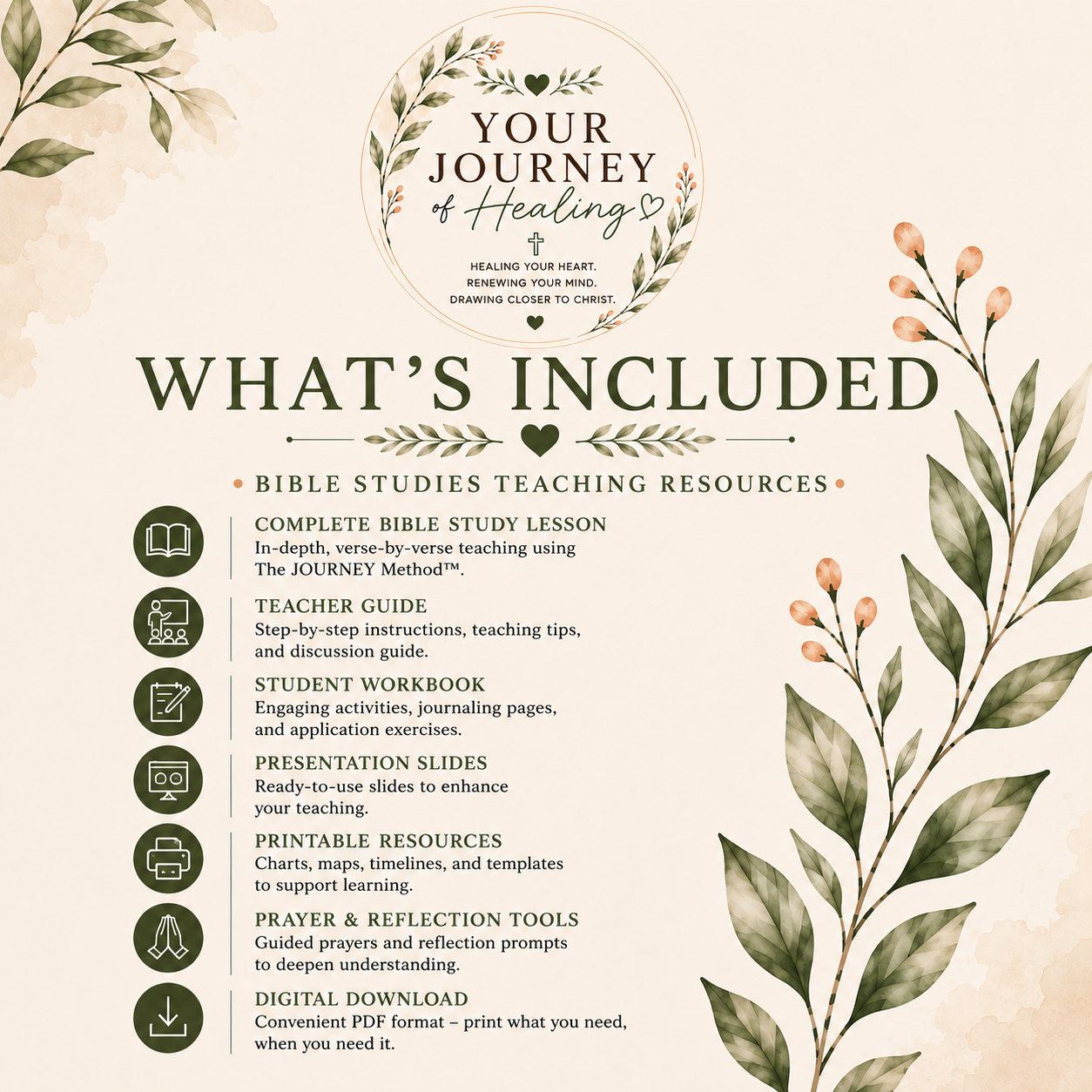
Stepping Out on Faith is a Scripture-centered Sunday School lesson exploring Matthew 14:22–33 and what Peter’s experience teaches us about courageous obedience, fear, uncertainty, keeping our eyes on Christ, and trusting God beyond what feels comfortable or controllable.
Inside This Lesson
- In-depth teaching from Matthew 14:22–33
- The context surrounding Jesus walking on water
- Why the disciples were in the storm
- Recognizing Jesus in unfamiliar circumstances
- Peter’s request to step onto the water
- The significance of Jesus saying “Come”
- Faith that responds through action
- The difference between faith and recklessness
- Leaving the security of the boat
- Fear and distraction
- What happened when Peter looked at the storm
- Jesus reaching for Peter
- Recovering when faith falters
- Trusting God without knowing every detail
- Practical application and reflection questions
- Group discussion prompts
- Prayer and personal response opportunities
They Were in the Storm Because Jesus Sent Them
One detail in Matthew 14 is easy to overlook.
The disciples did not enter the storm because they were disobedient.
Jesus had told them to get into the boat.
Sometimes we assume difficulty means we missed God.
But obedience does not guarantee calm circumstances.
You can be exactly where God directed you and still encounter wind.
“If It Is You…”
Peter does not simply jump out of the boat.
He asks Jesus:
“Lord, if it is You, command me to come.”
That distinction matters.
Biblical faith is not doing whatever feels bold and expecting God to support it.
Faith responds to God.
Before stepping out, we should ask:
Is this consistent with Scripture?
Is God leading me?
Am I responding in obedience—or simply acting impulsively?
Faith does not manufacture its own invitation.
It responds when Jesus says:
Come.
Getting Out of the Boat
The boat represented something Peter understood.
He was a fisherman.
He knew boats.
He understood water.
But Jesus was inviting him into a situation where experience could no longer sustain him.
Sometimes faith requires leaving what we can control.
A familiar routine.
A comfortable assignment.
A predictable plan.
An old identity.
A place where we know exactly what to expect.
Faith begins when obedience becomes more important than comfort.
Peter Actually Walked on Water
We often remember that Peter sank.
But before he sank:
Peter walked on water.
He did something impossible because his confidence was fixed on Christ.
Peter's story should not only be remembered as failure.
It is also a story of remarkable faith.
Eleven disciples stayed in the boat.
Peter stepped out.
When Peter Saw the Wind
The wind had been there before Peter left the boat.
What changed?
His focus.
Peter began looking at what surrounded him instead of the One who had called him.
Fear magnifies circumstances.
Faith magnifies the faithfulness of God.
The storm may be real.
The risk may be real.
The uncertainty may be real.
But none of those things make Jesus less trustworthy.
When Faith Falters
Peter begins sinking and cries:
“Lord, save me!”
Scripture says:
Immediately Jesus reached out His hand.
Peter's moment of fear did not cancel his relationship with Christ.
Jesus corrected him—but He also caught him.
That is important for anyone who has stepped out in faith and then struggled.
A moment of fear does not mean the entire journey is over.
Reach for Jesus again.
Faith Does Not Require the Whole Map
We often want God to explain:
Where this leads.
How long it will take.
What happens next.
How everything will work.
Peter received none of that.
He received one word:
Come.
Sometimes God gives enough direction for the next step rather than enough information for the entire journey.
Faith trusts Him with what has not yet been revealed.
What Is Your Boat?
The question is not simply whether Peter should have gotten out of his boat.
The question becomes:
What is Jesus asking you to trust Him with?
Maybe your boat is comfort.
Control.
Fear of failure.
Other people's approval.
Familiarity.
A past disappointment.
The need to know exactly what happens next.
You do not have to step everywhere.
You only need to step where Christ calls.
And when He does:
Keep your eyes on Him.
Take the step.
Trust His hand.
Because faith is not confidence in our ability to walk on water.
Faith is confidence in the One who called us out of the boat.
Key Themes: Faith • Courage • Trusting God • Obedience • Fear • Peter Walking on Water • Taking the Next Step • Christian Growth
Key Scriptures: Matthew 14:22–33 • Hebrews 11:1 • 2 Corinthians 5:7 • Proverbs 3:5–6 • Isaiah 41:10 • James 2:17
Format: Digital PDF — Instant Download
Perfect for Sunday School classes, women’s ministry, small groups, Bible studies, discipleship groups, or personal study.
Remember this: you are worthy, you are loved.
Share