Your Journey of Healing
Leviticus Bible Commentary PDF | Digital Bible Study | Verse-by-Verse Old Testament Study
Leviticus Bible Commentary PDF | Digital Bible Study | Verse-by-Verse Old Testament Study
Couldn't load pickup availability
Leviticus Bible Commentary PDF | A Verse-by-Verse Study of Holiness, Worship & Atonement
“Be holy because I, the LORD your God, am holy.” — Leviticus 19:2
Leviticus can feel intimidating.
Sacrifices. Priests. Rituals. Clean and unclean foods. Festivals. Blood. Atonement. Holiness.
Yet behind these unfamiliar laws is one central question:
How can a holy God dwell among sinful people?
Leviticus answers by showing Israel that access to God is both an extraordinary gift and a holy responsibility.
Leviticus Bible Commentary is a Scripture-centered study through all 27 chapters, helping you understand Israel’s sacrificial system, priesthood, purity laws, Day of Atonement, appointed festivals, covenant responsibilities, and the powerful connections between Leviticus and the work of Jesus Christ.
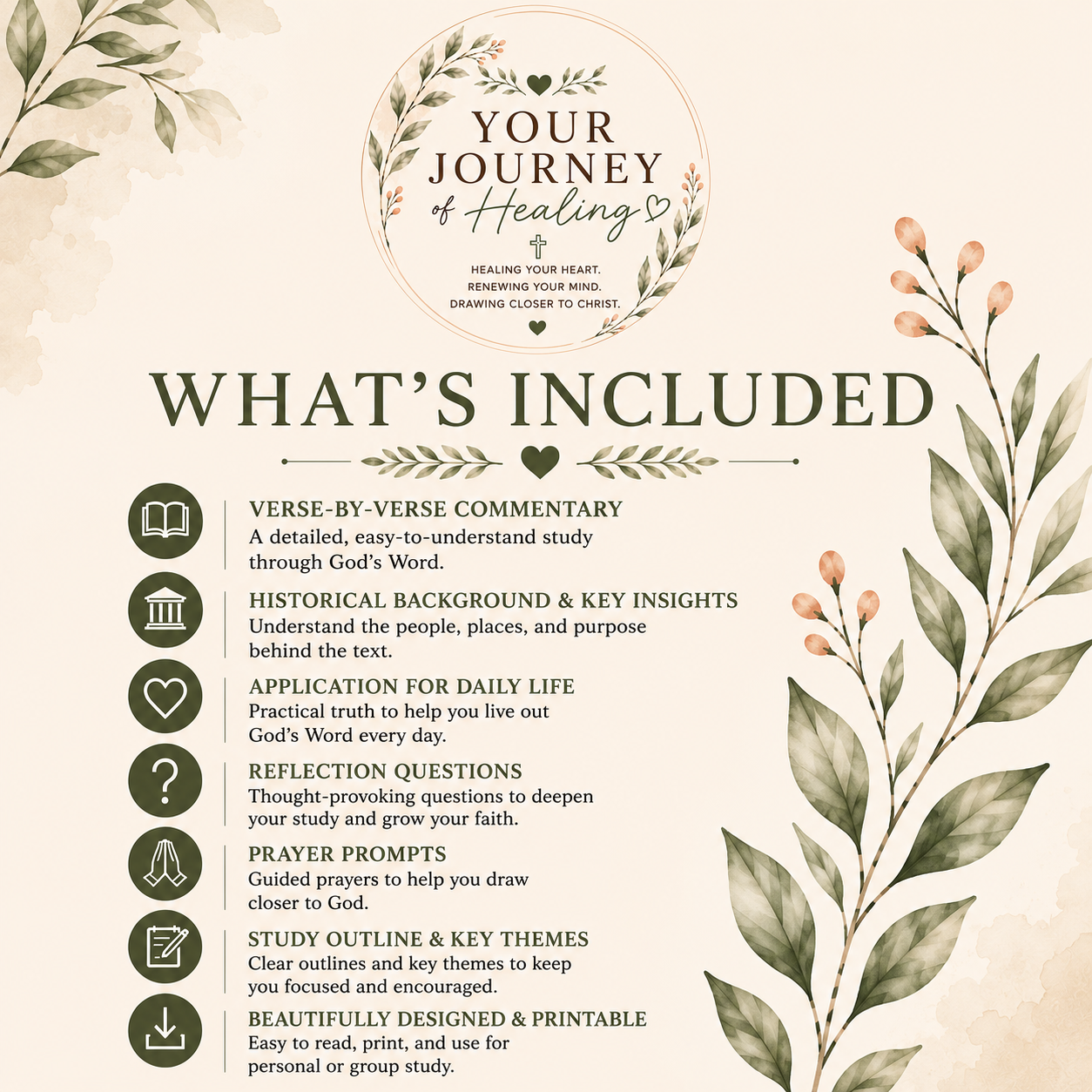
Inside This Study
- Commentary through all 27 chapters of Leviticus
- Historical and cultural background
- The five major offerings and their purposes
- The priesthood of Aaron and his sons
- Nadab and Abihu
- Clean and unclean distinctions
- Purity laws in their ancient Israelite context
- The Day of Atonement in Leviticus 16
- The meaning of sacrifice and blood
- The call to holiness
- “Love your neighbor as yourself”
- Sexual ethics and covenant faithfulness
- Israel’s appointed feasts and sacred calendar
- The Sabbath Year and Year of Jubilee
- Blessings, consequences, vows, and dedication
- Connections between Leviticus and Hebrews
- How the sacrificial system points toward Christ
- Practical application and reflection questions
A Holy God Among His People
Exodus ends with God’s glory filling the tabernacle.
Leviticus explains how Israel can live with God’s holy presence among them.
Holiness is therefore not an abstract theological concept.
God is holy, and His people are called to live differently because they belong to Him.
The repeated command is:
“Be holy, because I am holy.”
Sacrifice and Atonement
The opening chapters describe burnt offerings, grain offerings, fellowship offerings, sin offerings, and guilt offerings.
Each serves a particular purpose within Israel’s covenant worship.
These sacrifices teach that sin is serious, reconciliation matters, and approaching a holy God cannot be treated casually.
They also prepare us to understand something greater.
The New Testament presents Jesus as the once-for-all sacrifice whose work accomplishes what repeated animal sacrifices could never finally accomplish.
Leviticus gives us vocabulary for understanding the cross.
The Day of Atonement
Leviticus 16 describes Yom Kippur—the Day of Atonement.
Once each year, the high priest enters the Most Holy Place.
Sacrifice is made for sin, and one goat—the scapegoat—symbolically carries Israel’s sins away.
The imagery is powerful:
Sin must be atoned for.
Guilt must be removed.
The New Testament book of Hebrews later uses this imagery to explain the superior priesthood and sacrifice of Jesus.
Christ does not repeatedly enter with the blood of another.
He offers Himself.
What Does “Clean” Mean?
The clean and unclean laws can be confusing for modern readers.
Ritual uncleanness is not always identical to personal sinfulness.
Some conditions that made an Israelite ceremonially unclean were ordinary parts of human life.
These distinctions taught Israel about holiness, sacred space, worship, and approaching God within the covenant system He established for them.
Understanding that context prevents us from treating every Levitical regulation as though it functions identically for Christians today.
Love Your Neighbor
Buried among laws people often consider obscure is a command Jesus later identifies as one of the greatest:
“Love your neighbor as yourself.” — Leviticus 19:18
Leviticus connects holiness with everyday treatment of people.
Care for the poor.
Practice justice.
Pay workers fairly.
Respect others.
Reject dishonest business practices.
Do not seek revenge.
Holiness is not merely ceremonial.
It affects relationships.
Jubilee
Leviticus 25 introduces the Year of Jubilee.
Liberty is proclaimed.
Property is restored.
Debts and economic relationships are addressed.
People are reminded that ultimately the land belongs to God.
Jubilee communicates a powerful truth:
God’s people are stewards, not ultimate owners.
Everything belongs to Him.
Leviticus and Jesus
Leviticus becomes significantly clearer when read alongside the New Testament—especially Hebrews.
Priesthood.
Sacrifice.
Blood.
Atonement.
Cleansing.
Access to God.
All become essential categories for understanding what Jesus accomplished.
Leviticus shows us the seriousness of sin and holiness.
The Gospel shows us the extraordinary sufficiency of Christ.
Why Leviticus Still Matters
Christians are not ancient Israel living under the Mosaic covenant, yet Leviticus remains part of God’s inspired Word.
It teaches us that God is holy.
Sin matters.
Worship matters.
Justice matters.
Love for our neighbor matters.
Atonement matters.
And access to God should never be taken for granted.
Most importantly, Leviticus helps us appreciate the magnitude of what Jesus accomplished.
The repeated sacrifices anticipated something greater.
The priesthood anticipated a greater High Priest.
The Day of Atonement anticipated a greater atonement.
And through Christ, believers can approach the holy God Leviticus teaches us to reverence.
Key Themes: Holiness • Sacrifice • Atonement • Priesthood • Worship • Purity • Day of Atonement • Covenant • Jubilee • Jesus Christ
Key Scriptures: Leviticus 1–7 • Leviticus 10:1–3 • Leviticus 16 • Leviticus 17:11 • Leviticus 19:2 • Leviticus 19:18 • Leviticus 23 • Leviticus 25
Format: Digital PDF — Instant Download
Thank you for allowing Your Journey of Healing to be part of your journey through God’s Word. My prayer is that this commentary makes Leviticus easier to understand, deepens your appreciation for God’s holiness, and helps you see more clearly the extraordinary work of Jesus Christ.
Remember this: you are worthy, you are loved.
Share