Your Journey of Healing
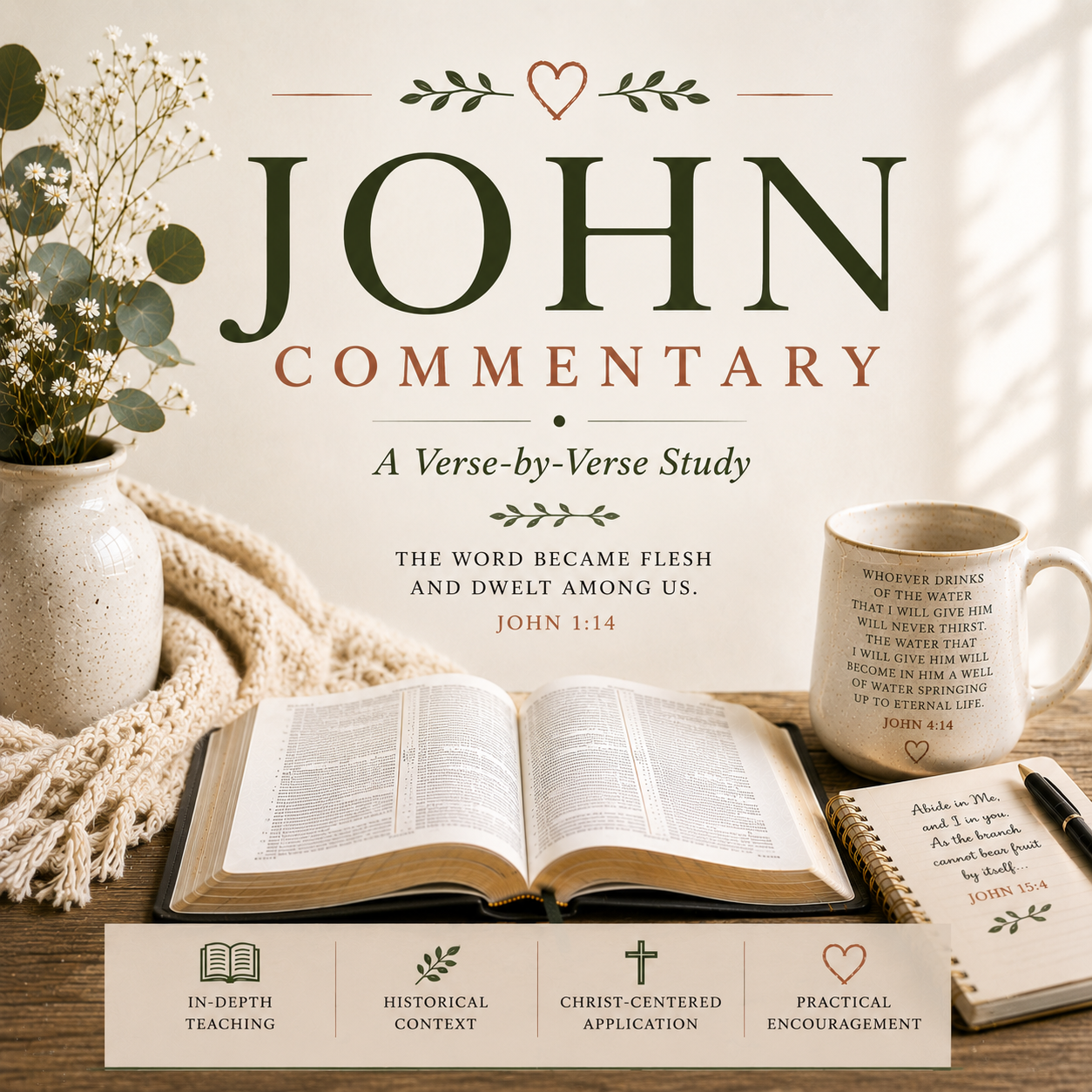
John Bible Commentary PDF | Digital Bible Study | Verse-by-Verse New Testament Study
John Bible Commentary PDF | Digital Bible Study | Verse-by-Verse New Testament Study
Couldn't load pickup availability
John Bible Commentary PDF | A Verse-by-Verse Study of Jesus Christ & the Gospel of Belief
“In the beginning was the Word, and the Word was with God, and the Word was God.” — John 1:1
John does not begin his Gospel in Bethlehem.
He begins before creation.
Before the manger.
Before Abraham.
Before humanity.
“In the beginning was the Word.”
From its opening sentence, the Gospel of John asks us to confront the most important question we will ever answer:
Who is Jesus?
John's answer is unmistakable.
Jesus is the eternal Word.
The Creator.
The Lamb of God.
The Bread of Life.
The Light of the World.
The Good Shepherd.
The Resurrection and the Life.
The Way, the Truth, and the Life.
The true Vine.
The Son of God.
And ultimately:
God who became flesh and dwelt among us.
John Bible Commentary is a Scripture-centered, verse-by-verse study designed to help you explore the Gospel of John, understand the identity and mission of Jesus Christ, and discover why John records these events so that we may believe and have life in His name.
The Word Became Flesh
John's Gospel begins with one of Scripture's clearest declarations concerning the deity of Christ.
“The Word was God.”
Then comes the extraordinary announcement:
“The Word became flesh and made his dwelling among us.”
The eternal Creator enters His creation.
God does not remain distant.
He comes near.
This truth becomes the foundation for everything that follows.
Inside you'll discover:
-
Verse-by-verse commentary through all 21 chapters of John
-
Historical and cultural background of the Gospel
-
The purpose and distinctive structure of John's Gospel
-
The deity and preexistence of Jesus Christ
-
The meaning of the Word — Logos
-
John the Baptist and the Lamb of God
-
An in-depth exploration of the signs recorded by John
-
The “I AM” statements of Jesus
-
Nicodemus and the meaning of being born again
-
Jesus and the Samaritan woman
-
Teaching on living water and true worship
-
The Bread of Life discourse
-
Jesus as the Good Shepherd
-
The raising of Lazarus
-
The Upper Room teaching of John 13–17
-
Jesus' teaching about the Holy Spirit
-
The death, burial, and resurrection of Christ
-
Thomas's confession of Jesus as Lord and God
-
Peter's restoration
-
John's purpose for writing his Gospel
-
Practical application for Christian faith and discipleship
-
Reflection questions for personal study and group discussion
-
A printable PDF for individual, Sunday School, or small group Bible study
The Signs Point Somewhere
John does not simply record miracles because they are extraordinary.
He calls them signs.
A sign points beyond itself.
Jesus turns water into wine.
He heals.
He feeds thousands.
He walks on water.
He gives sight to a man born blind.
He raises Lazarus from the dead.
Each sign reveals something about His identity.
The question is never simply:
“Did something miraculous happen?”
The deeper question is:
“What does this reveal about Jesus?”
The Seven “I AM” Statements
Throughout John, Jesus reveals His identity through a series of remarkable declarations:
“I am the bread of life.”
“I am the light of the world.”
“I am the gate.”
“I am the good shepherd.”
“I am the resurrection and the life.”
“I am the way and the truth and the life.”
“I am the true vine.”
These statements do more than describe what Jesus provides.
They reveal who Jesus is.
He does not merely give bread.
He is the Bread.
He does not merely show the way.
He is the Way.
He does not merely teach resurrection.
He is the Resurrection.
Christianity ultimately centers not merely on principles but on a Person.
“Before Abraham Was, I AM”
John also records another extraordinary statement.
Jesus tells His opponents:
“Before Abraham was born, I am!”
His listeners understand the significance immediately.
Jesus is not merely claiming to have existed before Abraham.
His language echoes God's revelation to Moses:
“I AM WHO I AM.”
John continually presents Jesus not merely as a teacher sent by God but as the eternal Son who shares the divine identity.
Encounters That Change People
John is filled with deeply personal encounters.
Nicodemus comes at night.
A Samaritan woman meets Jesus beside a well.
A man born blind receives sight.
Martha confronts Jesus in grief.
Thomas struggles to believe.
Peter carries the shame of denial.
Jesus meets each person differently.
He challenges.
He teaches.
He confronts.
He comforts.
He restores.
The Gospel reveals a Savior who knows exactly who stands before Him.
The Holy Spirit
John contains some of Jesus' most important teaching concerning the Holy Spirit.
Before the crucifixion, Jesus prepares His disciples for His departure.
He promises another Advocate.
The Spirit will teach.
Remind.
Testify about Christ.
Guide into truth.
Convict the world.
Jesus' physical departure does not mean His followers will be abandoned.
God will remain present with and within His people through the Holy Spirit.
“It Is Finished”
At the cross, Jesus declares:
“It is finished.”
These are not words of defeat.
They announce completion.
The work the Father gave Him has reached its appointed fulfillment.
Jesus gives His life.
John wants us to understand that the cross is not an accident that interrupts Jesus' mission.
The cross is central to His mission.
The Lamb of God gives Himself for the sins of the world.
The Empty Tomb
John's Gospel does not end at the cross.
Mary Magdalene discovers the empty tomb.
Peter and John run to investigate.
Thomas eventually stands before the risen Christ and declares:
“My Lord and my God!”
The confession brings John's Gospel full circle.
The One introduced in chapter 1 as God is confessed in chapter 20 as God.
“That You May Believe”
Near the end of his Gospel, John tells us exactly why he has written:
“These are written that you may believe that Jesus is the Messiah, the Son of God, and that by believing you may have life in his name.”
That is the invitation running through the entire book.
See the signs.
Hear the words.
Watch the encounters.
Stand beside the cross.
Look into the empty tomb.
And decide:
Who is Jesus?
John does not present that question merely for theological discussion.
Our answer determines everything.
Key Themes: Jesus Christ • Deity of Christ • The Word • I AM Statements • Signs & Miracles • Belief • Eternal Life • Holy Spirit • Love • Cross • Resurrection • Discipleship
Key Scriptures: John 1:1–18, John 1:29, John 3:3–17, John 4:13–14, John 6:35, John 8:12, John 8:58, John 10:11, John 11:25–26, John 14:6, John 15:5, John 16:7–15, John 19:30, John 20:28–31, John 21:15–19.
Format: Digital PDF (Instant Download)
Thank you for allowing Your Journey of Healing to be part of your journey through God's Word. My prayer is that this commentary helps you understand the Gospel of John more deeply, see Jesus more clearly, and move beyond simply knowing about Him toward believing, abiding, and finding life in His name.
Remember this: you are worthy, you are loved.
Share